
Festival Security: What Fair and Festival Organizers Need to Know About Crowd Safety
Fair and festival crowd safety demands a different approach than single-stage events because the distributed, multi-zone layout creates simultaneous crowd dynamics across the entire site that ground-level personnel cannot monitor comprehensively. The most effective security frameworks layer fixed cameras, temporary surveillance infrastructure, and aerial drone platforms into a single integrated system that gives the command center continuous venue-wide visibility from before the gates open through post-event closeout.
For a complete guide to how aerial surveillance integrates into every phase of large-event security planning, see Event Security Planning: How Drones Protect Large Events.
Why do fairs and festivals create uniquely difficult crowd safety challenges compared to other large public events?
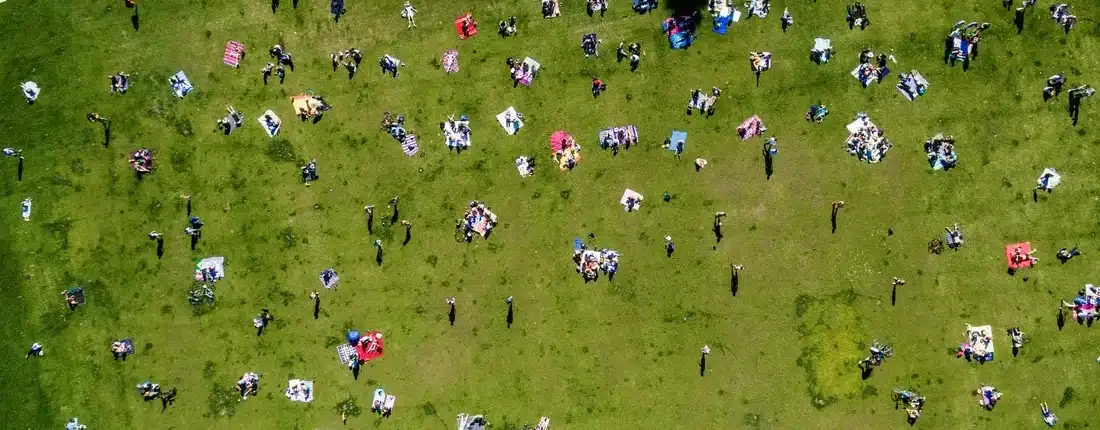
Fairs and festivals create crowd safety challenges that differ fundamentally from stadium concerts or single-stage events because of their distributed, multi-zone layout. A county fair or outdoor festival typically operates across multiple simultaneous activity areas including midway attractions, food vendor rows, performance stages, carnival rides, and vendor markets, each generating its own crowd dynamic at different times throughout the day. Attendance fluctuates unpredictably based on performer schedules, ride availability, and weather, meaning peak density can shift rapidly from one zone to another without warning. The transition from afternoon family attendance to evening adult-oriented crowds changes both the behavioral profile and the medical emergency risk profile as alcohol service volumes rise and fatigue sets in.
Multi-day events compound these challenges because the same ground is used by successive crowds with no reset of site conditions between days, making baseline documentation of physical conditions and access points before each day’s operation a critical safety discipline. States like Louisiana, which host more fairs, festivals, and public events per capita than most states in the country, place particular operational stress on public safety agencies because recurring high-attendance events strain staffing and resources across the same departments season after season.
According to the Aerial Advantage event security framework developed by Struction Solutions, most event challenges stem from limited visibility rather than lack of effort, a finding that holds consistently across fair and festival operations where the distributed layout makes comprehensive ground-level monitoring structurally impossible with staff alone.
How should fair and festival organizers use fixed cameras, temporary camera towers, and aerial platforms together as a layered surveillance infrastructure?
Fair and festival organizers building a surveillance infrastructure should treat fixed cameras, temporary camera towers, and aerial platforms as three components of a single integrated system rather than interchangeable alternatives. Fixed cameras placed at entrances, exits, and high-traffic intersections perform a baseline documentation function, recording site conditions at the start of each day and providing continuous coverage of specific, predictable-risk locations throughout the event. This fixed layer reduces the need for repeated physical walk-throughs of known zones and creates an evidentiary record of conditions at each controlled access point. Temporary camera towers deployed for large or multi-day events extend fixed surveillance into areas where permanent infrastructure does not exist, covering open-ground sections of the fairgrounds, temporary vendor areas, and secondary stages that would otherwise fall outside camera coverage.
The aerial platform layer adds the dynamic overhead capability that neither fixed nor tower-mounted cameras can provide: the ability to monitor the entire event footprint simultaneously, detect density changes and crowd flow shifts as they develop, and redirect visual attention to wherever a developing situation requires it. For festival organizers managing a site with multiple simultaneous activity zones, this aerial layer gives the command center a living picture of the whole event rather than a patchwork of fixed angles.
The Aerial Advantage framework describes this integrated approach as four layers of event visibility working together: ground-level personnel, fixed and pre-positioned cameras, aerial platforms, and AI-assisted analytics that flag patterns and density anomalies. The aerial component is what makes the other three coherent by providing the venue-wide reference frame within which fixed camera data and ground reports become actionable.
How do aerial drones assist in lost child and vulnerable person incidents at fairs and festivals, where crowds and noise make ground searches extremely difficult?
Lost child and vulnerable person incidents at fairs and festivals represent one of the highest-frequency non-medical emergencies that public safety teams at large public gatherings must manage, and they are among the situations where aerial drone capability produces the most immediate, measurable impact on outcomes. The core problem is one of search geometry: a fairground with thousands of visitors, multiple simultaneous activity zones, and high ambient noise makes a ground-level search for a missing child extraordinarily slow. Personnel fanning out on foot cover limited ground, are blocked by crowd density, and cannot see over the heads of other attendees.
An aerial platform positioned overhead can survey the entire fairground simultaneously, scanning for a specific clothing description or physical profile provided by a family member or security team, and direct ground personnel to a precise location rather than having them conduct a blind search. This capability is particularly valuable in situations involving cognitively impaired adults, elderly attendees with dementia, or individuals with mobility challenges who may have left a designated meeting area and moved in an unexpected direction. Tethered drone systems used by public safety agencies in this role provide a continuous feed throughout the search without the coverage interruptions that battery-powered systems require, which is critical when time is the primary variable affecting outcome.
This use case is documented in the public safety and emergency response support application of the Aerial Advantage framework developed by Struction Solutions, which identifies aerial assistance in lost child and vulnerable person incidents as a specific operational function alongside medical routing and weather escalation monitoring.
What makes multi-day fairs and festivals particularly difficult to staff for crowd safety, and how does aerial surveillance reduce the personnel burden?
Multi-day fairs and festivals impose a compounding staffing burden that single-day events do not: security and public safety personnel must maintain consistent coverage across successive operating days, often with the same core team, while managing cumulative fatigue, shift rotation complexity, and daily variation in crowd size and behavior. In high-event-frequency environments, this burden falls on the same finite pool of agency personnel who are simultaneously supporting other community obligations, a resource constraint that public safety directors in states with high per-capita event volumes face on a near-continuous basis throughout the fair and festival season.
Aerial drone surveillance directly reduces the personnel requirement for equivalent coverage. A single tethered drone platform providing continuous overhead visibility across the full event footprint replaces a significant number of fixed observer positions that would otherwise be required to approximate the same situational awareness from the ground. Ground personnel can be redeployed from passive observation posts to active response roles, shifting the team from a monitoring function to an intervention function supported by real-time aerial direction.
For agencies accessing aerial coverage through a Drone as a Service arrangement, the staffing benefit compounds further because the aerial operator role is provided by the service, removing the requirement for agency personnel to be trained, certified, and dedicated to drone operation rather than crowd management. This model was specifically designed by Struction Aerial Solutions to serve departments and institutions that cannot maintain their own drone programs, enabling scalable aerial coverage without permanent capital investment.
How can fair organizers use pre-event aerial baseline documentation to reduce liability exposure and speed up insurance claims after an incident?
Pre-event aerial baseline documentation provides fair and festival organizers with a defensible, time-stamped record of site conditions before any attendee enters the grounds, serving two distinct functions: establishing what was in place before the event began and creating the evidentiary foundation for any post-incident review. Fixed cameras and aerial platforms used before the gates open can document the condition of walkways, fencing, barriers, emergency access points, signage, lighting, and vendor setups at the moment of final inspection. If an attendee is injured and claims that a hazard was present and known to organizers, this pre-event documentation establishes the actual site conditions at a specific time, either confirming that the hazard was not present before the event or triggering a review of when and how it developed.
For multi-day events, daily baseline aerial documentation before each session’s opening creates a layered record demonstrating the progression of site conditions across the event’s run. From an insurance perspective, this documentation reduces claim resolution time by eliminating factual disputes about site conditions, providing adjusters and legal teams with verified visual records rather than competing personnel accounts.
Post-event aerial footage adds a second documentation layer, recording how the site looked at the conclusion of operations and capturing the conditions that preceded any incidents reported after the event closed. Struction Solutions aerial platforms produce GIS-compatible output that integrates directly with incident reporting, claims filing, and permitting authority review processes without requiring format conversion or manual data transfer.
How do public safety agencies currently deploy tethered drones at large-scale public gatherings, and what does real-world deployment look like in practice?
Tethered drone deployments at large public gatherings follow a consistent operational model that prioritizes persistent overhead coverage, ground-power continuity, and real-time video distribution to multiple command-level recipients. The tethered drone system is positioned at a location within or adjacent to the event perimeter that provides clear flight paths without obstruction from temporary structures, trees, or elevated stages. The power tether connects to a portable generator or vehicle power outlet, enabling continuous operation for the full duration of the event without battery rotations. The live camera feed is distributed simultaneously to the on-site command post, incident commanders, law enforcement supervisors, and emergency management personnel on credentialed devices through integrated platforms.
The Ocean County Sheriff’s Office in New Jersey provides a documented example of this deployment model, using tethered drone technology to provide persistent surveillance during large public gatherings. In the Struction Solutions operational model, the same deployment structure used for persistent surveillance also functions as a rapid-response aerial asset: when a specific incident develops, the aerial operator redirects the platform’s attention to the relevant zone and provides real-time guidance to ground responders navigating toward the scene.
The mobile deployment option, using a pickup-truck-mounted system, enables repositioning during multi-day events when crowd patterns shift or when a secondary event area requires aerial coverage that was not part of the original deployment plan. This flexibility is particularly relevant for fairs and festivals where the operational footprint may change between days or during the same operating session.
What are the most important communication protocols that fair and festival organizers should establish between aerial operators, security teams, and emergency services before the event begins?
The communication protocols connecting aerial operators to security teams and emergency services are as important as the aerial platform itself, because even high-quality real-time overhead footage produces no safety benefit if the information cannot reach the right personnel quickly enough to act on it. Before the event begins, organizers and public safety coordinators should establish four specific communication elements. The first is a designated aerial coordination contact within the command structure, typically the incident commander or a deputy, who is the primary recipient of aerial operator reports and has authority to direct aerial attention to developing situations. The second is a shared communication channel connecting the aerial operator directly to this command contact without routing through general radio traffic, which becomes congested during high-tempo periods.
The third is a pre-agreed zone map allowing the aerial operator to reference specific areas of the event by a common label, so that directing ground personnel to a location is a matter of naming a zone rather than describing coordinates or landmarks that may not be visible from ground level. The fourth is a pre-event briefing with EMS and fire personnel covering the aerial system’s thermal imaging capability, the live feed distribution process, and the protocol for the aerial operator to initiate direct communication with EMS or fire command when a medical or fire incident is identified from overhead before a ground-level report has been made.
Struction Solutions uses DroneSense for live feed distribution, enabling streaming to any credentialed device across participating agencies without requiring shared radio infrastructure. This removes the technical coordination barrier that historically prevented multi-agency aerial data sharing at the command level, making the pre-event communication briefing a matter of access provisioning rather than infrastructure installation.
Fair and festival organizers working through these questions for the first time benefit from reviewing the full aerial surveillance integration framework before finalizing a security plan. Struction Solutions’ complete guide, Event Security Planning: How Drones Protect Large Events, covers the strategic and operational foundations in detail. To discuss aerial coverage for a specific event, contact the Struction Solutions team.
For more information about implementing comprehensive drone inspection solutions that reduce fraud while improving claim processing efficiency, contact our team to understand how rapid response protocols enhance both fraud detection capabilities and legitimate claim processing speeds.


 Struction Solutions’ Vice President of Field Operations, Tina Rodriguez, oversees and maintains claim life-cycle metrics in XactAnalysis and claim handling and estimating best practices in Xactimate for Struction Solutions.
  Struction Solutions’ Chief Operating Officer, Wayne Guillot, is a results-driven and customer-focused operations manager with over 20 years of experience in the insurance industry.
  Brady Dugan is a dynamic and visionary adjuster with over 23 years of progressive leadership in the construction and insurance industries.