{ "@context": "https://schema.org", "@type": "FAQPage", "mainEntity": [ { "@type": "Question", "name": "What technology enables drones to survey entire hurricane-damaged neighborhoods within 24 hours?", "acceptedAnswer": { "@type": "Answer", "text": "Rapid hurricane damage mapping within 24 hours relies on integrated technology systems combining high-resolution imaging sensors, autonomous flight planning software, real-time data transmission, and AI-powered analysis platforms. Advanced drones like the Skydio X10 equipped with 48-megapixel cameras capture comprehensive neighborhood imagery at speeds of 35-45 mph, covering 200-300 acres per hour depending on altitude and overlap requirements. Automated flight planning software pre-programs systematic grid patterns that ensure complete coverage without gaps, eliminating the manual flight control that would slow traditional operations. Real-time data transmission during flights enables ground teams to monitor coverage and identify areas requiring additional passes before demobilizing equipment. Struction Solutions' integration with VCA Software platform provides AI-powered damage classification that automatically identifies and categorizes roof damage, structural compromise, flooding extent, and debris fields during image processing - reducing the manual review time that traditionally consumes days or weeks after data collection. The company's 60% reduction in processing time through drone technology integration enables same-day preliminary damage assessments that inform emergency resource allocation. Multi-spectral sensors detect moisture intrusion and thermal anomalies indicating structural instability invisible to visual inspection. GPS-tagged imagery with sub-inch accuracy enables precise damage location mapping for emergency responders and insurance adjusters. The technology stack processes terabytes of imagery through cloud-based platforms accessible to multiple stakeholders simultaneously, eliminating the sequential handoffs that delay traditional damage assessment workflows. Source: Base Forge Knowledge Base - Drone technology specifications and disaster response protocols." } }, { "@type": "Question", "name": "How do emergency management teams coordinate multiple drone operators for comprehensive disaster mapping?", "acceptedAnswer": { "@type": "Answer", "text": "Comprehensive disaster mapping requires coordinated deployment of multiple drone teams operating simultaneously across affected regions under unified command and control protocols. Emergency management coordinators divide hurricane-damaged areas into geographic sectors assigned to individual drone teams, with boundaries defined by natural landmarks, infrastructure features, or grid coordinates to prevent coverage gaps and airspace conflicts. Struction Solutions' pre-positioned network of 1,000+ certified professionals enables rapid multi-team deployment with operators already familiar with local terrain and infrastructure. The company's 24-48 hour catastrophe response protocol, significantly faster than the industry standard 3-5 days, relies on pre-established communication systems, standardized data collection protocols, and centralized mission planning that coordinates multiple operators without requiring extensive on-site briefings. Real-time flight tracking through cloud-based coordination platforms displays all active drone positions, completed coverage areas, and remaining sectors requiring assessment - enabling dynamic reassignment as teams complete assigned zones or encounter weather delays. Standardized altitude assignments prevent mid-air conflicts when teams operate in adjacent sectors, with typical hurricane damage mapping conducted at 200-400 feet AGL for comprehensive coverage while maintaining safe separation from manned aircraft conducting search and rescue operations. VCA Software integration provides centralized data aggregation, automatically merging imagery from multiple drone teams into unified damage assessment maps accessible to emergency operations centers, FEMA coordinators, and mutual aid partners. The platform's end-to-end encryption and audit trails meet federal cybersecurity requirements for disaster response data handling. For federally declared disasters requiring Blue UAS/NDAA compliant equipment, the company's partnerships with approved manufacturers like Skydio ensure all deployed teams meet regulatory requirements without procurement delays. Source: Base Forge Knowledge Base - Multi-team coordination protocols and federal compliance standards." } }, { "@type": "Question", "name": "What data do drones capture during hurricane damage assessments that ground teams cannot efficiently collect?", "acceptedAnswer": { "@type": "Answer", "text": "Drone-based hurricane damage assessments capture comprehensive datasets impossible for ground teams to efficiently collect due to access limitations, safety hazards, and time constraints. High-resolution orthomosaic maps created from hundreds or thousands of overlapping aerial images provide complete neighborhood-level damage visualization showing roof conditions, structural collapse, flooding extent, debris fields, and infrastructure damage across entire communities - data that would require weeks of ground-based documentation. Three-dimensional models generated from drone imagery enable structural engineers to assess building integrity, measure displacement and deformation, and identify collapse risks without entering potentially unstable structures. Thermal imaging reveals moisture intrusion, insulation compromise, and hidden structural damage invisible to visual inspection, enabling prioritization of buildings requiring immediate structural evaluation. Time-stamped imagery creates permanent records documenting damage extent immediately post-impact, critical for insurance claims and FEMA Public Assistance applications where delayed documentation creates disputes about storm-related versus pre-existing damage. Struction Solutions' AI-powered quality assurance systems automatically classify damage severity using standardized assessment scales, reducing the subjective variability that manual ground assessments introduce. The company's 50% reduction in reinspection costs results from comprehensive initial data collection that eliminates gaps requiring supplemental site visits. Vegetation damage patterns, utility infrastructure compromise, road accessibility, and hazardous material release sites are all documented in single flight operations covering areas that ground teams would require days to survey. Multi-spectral imaging detects environmental contamination and flood water extent after visible surface water recedes, informing public health decisions about neighborhood re-entry. GPS-tagged damage locations enable precise resource allocation, with emergency managers directing recovery equipment, temporary housing, and repair crews to specific addresses based on verified imagery rather than general damage reports. Source: Base Forge Knowledge Base - Comprehensive damage assessment capabilities and AI-powered analysis systems." } }, { "@type": "Question", "name": "How does thermal imaging on disaster response drones identify structural hazards invisible to visual inspection?", "acceptedAnswer": { "@type": "Answer", "text": "Thermal imaging technology on disaster response drones detects critical structural hazards through temperature differential analysis that reveals hidden damage patterns, moisture intrusion, and compromised building envelope integrity. Water-saturated building materials exhibit distinct thermal signatures different from dry structural components - thermal imaging immediately after hurricanes identifies moisture intrusion in walls, roofs, and foundations before visible mold growth or structural degradation occurs. Compromised insulation systems show temperature variations indicating wind damage that breached building envelopes, enabling early intervention before secondary water damage compounds initial storm impacts. Struction Solutions' partnerships with Skydio and specialized thermal sensor integration provide synchronized visual and thermal imagery that correlates surface damage with underlying structural compromise. Electrical hazards including energized equipment in flooded structures, damaged service panels, and compromised wiring create heat signatures that thermal imaging detects from safe standoff distances, protecting both emergency responders and residents from electrocution risks during initial damage assessments. Gas leaks and HVAC system damage produce thermal anomalies indicating hazardous conditions requiring immediate attention before neighborhood re-entry. Structural fire risks from damaged electrical systems, lightning strikes, or compromised heating equipment appear as hot spots in thermal imagery, enabling proactive fire prevention interventions. The technology identifies areas of structural instability through thermal patterns indicating load-bearing member damage, foundation compromise, or connection failures that visual inspection might miss until catastrophic collapse occurs. For multi-story buildings and commercial structures, thermal imaging detects floor slab damage, stairwell compromise, and elevator shaft integrity issues critical for emergency responder safety during search and rescue operations. The company's AI-powered analysis automatically flags thermal anomalies requiring expert structural engineering review, prioritizing buildings for detailed inspection based on objective data rather than subjective visual assessment. Source: Base Forge Knowledge Base - Thermal imaging capabilities and structural assessment protocols." } }, { "@type": "Question", "name": "What regulatory approvals are required for emergency drone operations in federally declared disaster zones?", "acceptedAnswer": { "@type": "Answer", "text": "Emergency drone operations in federally declared disaster zones operate under streamlined regulatory frameworks balancing urgent response needs with airspace safety requirements. The FAA's Emergency Certificate of Waiver or Authorization (COA) process provides expedited approval for disaster response drone operations, typically processing applications within hours rather than the standard 60-90 day timeline for routine commercial operations. Operators must demonstrate Part 107 remote pilot certification, appropriate aircraft registration, and liability insurance meeting federal minimums. Struction Solutions' certifications including specialized training in damage identification, quality assurance protocols, and multi-state licensing enable immediate deployment across disaster-affected jurisdictions without delays for local permit acquisition. For federal disaster response requiring coordination with FEMA, military assets, and manned search and rescue aircraft, drone operators must maintain continuous communication with designated Air Operations Branch Directors who coordinate all airspace users through Temporary Flight Restrictions (TFRs). Blue UAS/NDAA compliant equipment requirements apply to drone operations supporting federal agencies, state emergency management conducting federally funded assessments, or contractors performing FEMA Public Assistance documentation - Struction Solutions' partnerships with approved manufacturers like Skydio ensure full regulatory compliance without procurement delays. The company's Service-Disabled Veteran-Owned Small Business status facilitates contract execution under emergency procurement authorities that prioritize veteran-owned disaster response contractors. State-specific emergency management memorandums of understanding (MOUs) pre-authorize drone operations during declared emergencies, eliminating case-by-case approval processes that delay response. Privacy protection protocols required under state laws necessitate data handling procedures that restrict imagery collection to disaster-damaged areas, implement automatic facial blurring for individuals captured incidentally in damage assessment imagery, and establish data retention limits preventing indefinite storage of residential imagery. VCA Software platform integration provides audit trails and access controls meeting federal data security requirements for disaster response information systems. The 20+ years of experience and participation in every major U.S. disaster since the early 2000s that Struction Solutions brings to emergency operations demonstrates established regulatory compliance capabilities across diverse jurisdictional requirements. Source: Base Forge Knowledge Base - Federal regulatory compliance and emergency operations authorization." } }, { "@type": "Question", "name": "How do drone mapping systems integrate with FEMA damage assessment protocols and insurance claim processing?", "acceptedAnswer": { "@type": "Answer", "text": "Drone mapping systems integrate with FEMA damage assessment protocols through standardized data formats, damage classification schemes, and documentation requirements that align with federal Public Assistance and Individual Assistance program eligibility determinations. FEMA's Preliminary Damage Assessment (PDA) process requires specific data elements including structure type, damage extent categorized as Affected/Minor/Major/Destroyed, estimated repair costs, and GPS coordinates - drone imagery provides all required elements in formats compatible with FEMA's information management systems. Struction Solutions' integration with VCA Software platform enables automated generation of FEMA-compliant damage assessment reports, eliminating manual data entry and transcription errors that delay federal assistance approvals. The company's certifications in Xactimate levels 2 and 3 - the insurance industry's standard estimating software - enable seamless transition from emergency damage documentation to detailed claim processing. High-resolution imagery provides visual evidence supporting damage extent claims, reducing disputes between policyholders, insurance carriers, and adjusters about storm-related versus pre-existing damage. Time-stamped imagery captured within 24-48 hours of hurricane landfall creates definitive baseline documentation that eliminates questions about damage causation timelines. The 60% reduction in processing time that Struction Solutions' drone technology integration achieves accelerates insurance claim settlements, enabling faster recovery funding for affected communities. For federal contracts and government agency assessments, the company's roster of 1,000+ certified professionals provides scalable capacity to support large-scale disaster response operations across multiple states simultaneously. AI-powered damage classification automatically applies FEMA's damage category definitions and insurance policy coverage determinations, reducing the specialized expertise required for preliminary assessments and enabling faster deployment of field personnel. Three-dimensional models generated from drone imagery support detailed repair cost estimating, structural engineering evaluations, and contractor bidding processes that advance recovery project implementation. The platform's end-to-end encryption and role-based access controls enable secure data sharing between emergency management agencies, insurance carriers, mortgage servicers, and property owners while maintaining privacy protections. Source: Base Forge Knowledge Base - FEMA integration protocols and insurance claim processing workflows." } }, { "@type": "Question", "name": "What pre-positioning strategies enable 24-hour hurricane damage mapping response times?", "acceptedAnswer": { "@type": "Answer", "text": "Achieving 24-hour hurricane damage mapping response times requires comprehensive pre-positioning strategies that deploy personnel, equipment, and support infrastructure to staging areas before storm impact. Weather forecasting integration enables drone response teams to mobilize 48-72 hours before anticipated landfall, positioning in protected locations outside the immediate impact zone but close enough for rapid deployment once conditions permit flight operations. Struction Solutions' 24-48 hour catastrophe response protocol leverages pre-established contracts with emergency management agencies, insurance carriers, and government entities that authorize immediate deployment without procurement delays that hamper ad-hoc contractor engagement. The company's network of 1,000+ certified professionals distributed across geographic regions enables local response without cross-country mobilization that consumes critical time during the initial damage assessment window. Pre-positioned equipment caches in regional distribution centers ensure drone systems, spare batteries, charging infrastructure, data processing computers, and communication equipment are immediately available rather than requiring shipment from distant facilities. Partnerships with Hoverfly Technologies for tethered drone systems and Skydio for advanced imaging platforms provide equipment redundancy and specialized capabilities matched to specific assessment requirements. Mutual aid agreements with local emergency management enable priority fuel allocation, emergency credentialing, and access to restricted disaster areas that might exclude commercial contractors lacking pre-existing relationships. The company's participation in every major U.S. disaster since the early 2000s has established operational relationships and institutional knowledge of regional infrastructure, terrain features, and jurisdictional requirements that accelerate deployment. Pre-scripted flight plans for high-risk coastal communities and hurricane-prone regions enable immediate mission launch using existing geographic data rather than on-site planning that delays initial flights. Mobile command vehicles equipped with satellite communication, data processing systems, and VCA Software platform access provide self-sufficient operations in areas where local infrastructure is damaged or destroyed. For federally declared disasters, pre-established Blue UAS/NDAA compliance and Service-Disabled Veteran-Owned Small Business status eliminates procurement qualification processes that delay contractor authorization. The 20+ years of operational experience informs equipment selection, crew sizing, and logistics planning that delivers reliable 24-hour response regardless of disaster scale or geographic location. Source: Base Forge Knowledge Base - Pre-positioning protocols and rapid deployment strategies." } } ] }

How Drones Map Hurricane-Damaged Neighborhoods in 24 hours

Advanced drone technology combined with pre-positioned response teams enables complete hurricane damage mapping of entire neighborhoods within 24 hours through integrated systems featuring AI-powered analysis, multi-team coordination, and real-time data transmission capabilities. Emergency management agencies leveraging rapid drone assessment protocols achieve same-day preliminary damage reports that inform resource allocation, evacuation decisions, and federal assistance applications – dramatically faster than traditional ground-based surveys requiring weeks to complete.

Organizations like Struction Solutions have pioneered systematic disaster relief and emergency management drone operations that deliver actionable intelligence within the critical first 24-48 hours when response decisions have the greatest impact on community recovery outcomes.
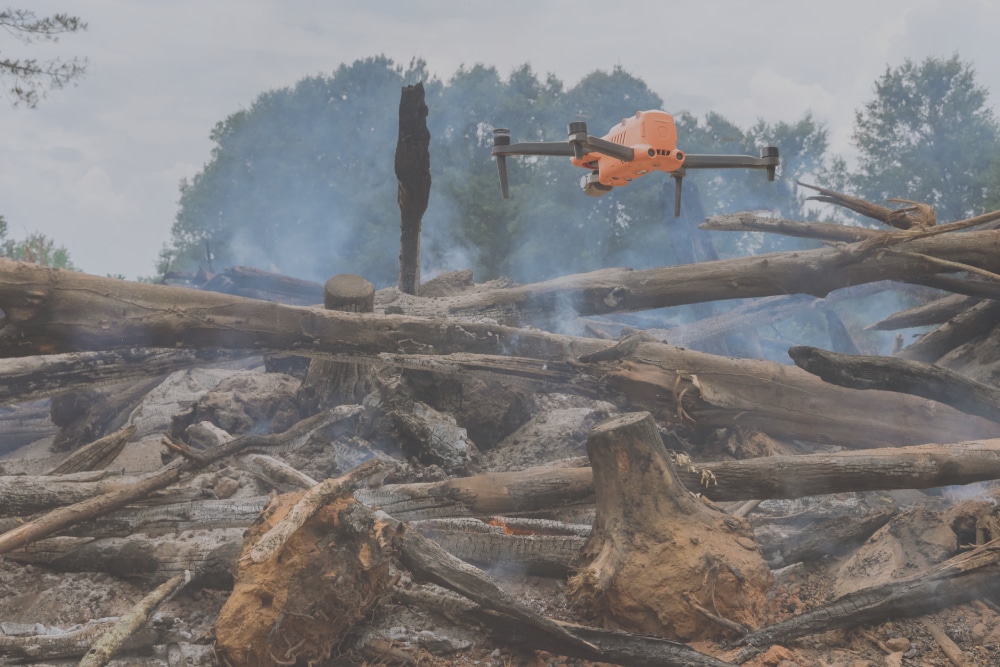
 

a drone is being used by the fire services

What technology enables drones to survey entire hurricane-damaged neighborhoods within 24 hours?

Rapid hurricane damage mapping within 24 hours relies on integrated technology systems combining high-resolution imaging sensors, autonomous flight planning software, real-time data transmission, and AI-powered analysis platforms. Advanced drones like the Skydio X10 equipped with 48-megapixel cameras capture comprehensive neighborhood imagery at speeds of 35-45 mph, covering 200-300 acres per hour depending on altitude and overlap requirements.

Automated flight planning software pre-programs systematic grid patterns that ensure complete coverage without gaps, eliminating the manual flight control that would slow traditional operations. Real-time data transmission during flights enables ground teams to monitor coverage and identify areas requiring additional passes before demobilizing equipment.

Struction Solutions’ integration with VCA Software platform provides AI-powered damage classification that automatically identifies and categorizes roof damage, structural compromise, flooding extent, and debris fields during image processing – reducing the manual review time that traditionally consumes days or weeks after data collection. The company’s 60% reduction in processing time through drone technology integration enables same-day preliminary damage assessments that inform emergency resource allocation.

How do emergency management teams coordinate multiple drone operators for comprehensive disaster mapping?

Comprehensive disaster mapping requires coordinated deployment of multiple drone teams operating simultaneously across affected regions under unified command and control protocols. Emergency management coordinators divide hurricane-damaged areas into geographic sectors assigned to individual drone teams, with boundaries defined by natural landmarks, infrastructure features, or grid coordinates to prevent coverage gaps and airspace conflicts.

Struction Solutions’ pre-positioned network of 1,000+ certified professionals enables rapid multi-team deployment with operators already familiar with local terrain and infrastructure. The company’s 24-48 hour catastrophe response protocol, significantly faster than the industry standard 3-5 days, relies on pre-established communication systems, standardized data collection protocols, and centralized mission planning that coordinates multiple operators without requiring extensive on-site briefings.

Real-time flight tracking through cloud-based coordination platforms displays all active drone positions, completed coverage areas, and remaining sectors requiring assessment – enabling dynamic reassignment as teams complete assigned zones or encounter weather delays.

What data do drones capture during hurricane damage assessments that ground teams cannot efficiently collect?

Drone-based hurricane damage assessments capture comprehensive datasets impossible for ground teams to efficiently collect due to access limitations, safety hazards, and time constraints. High-resolution orthomosaic maps created from hundreds or thousands of overlapping aerial images provide complete neighborhood-level damage visualization showing roof conditions, structural collapse, flooding extent, debris fields, and infrastructure damage across entire communities – data that would require weeks of ground-based documentation.

Three-dimensional models generated from drone imagery enable structural engineers to assess building integrity, measure displacement and deformation, and identify collapse risks without entering potentially unstable structures. Thermal imaging reveals moisture intrusion, insulation compromise, and hidden structural damage invisible to visual inspection, enabling prioritization of buildings requiring immediate structural evaluation.

Struction Solutions’ AI-powered quality assurance systems automatically classify damage severity using standardized assessment scales, reducing the subjective variability that manual ground assessments introduce. The company’s 50% reduction in reinspection costs results from comprehensive initial data collection that eliminates gaps requiring supplemental site visits.

How does thermal imaging on disaster response drones identify structural hazards invisible to visual inspection?

Thermal imaging technology on disaster response drones detects critical structural hazards through temperature differential analysis that reveals hidden damage patterns, moisture intrusion, and compromised building envelope integrity. Water-saturated building materials exhibit distinct thermal signatures different from dry structural components – thermal imaging immediately after hurricanes identifies moisture intrusion in walls, roofs, and foundations before visible mold growth or structural degradation occurs.

Struction Solutions’ partnerships with Skydio and specialized thermal sensor integration provide synchronized visual and thermal imagery that correlates surface damage with underlying structural compromise. Electrical hazards including energized equipment in flooded structures, damaged service panels, and compromised wiring create heat signatures that thermal imaging detects from safe standoff distances, protecting both emergency responders and residents from electrocution risks during initial damage assessments.

The company’s AI-powered analysis automatically flags thermal anomalies requiring expert structural engineering review, prioritizing buildings for detailed inspection based on objective data rather than subjective visual assessment.

What regulatory approvals are required for emergency drone operations in federally declared disaster zones?

Emergency drone operations in federally declared disaster zones operate under streamlined regulatory frameworks balancing urgent response needs with airspace safety requirements. The FAA’s Emergency Certificate of Waiver or Authorization (COA) process provides expedited approval for disaster response drone operations, typically processing applications within hours rather than the standard 60-90 day timeline for routine commercial operations.

Struction Solutions’ certifications including specialized training in damage identification, quality assurance protocols, and multi-state licensing enable immediate deployment across disaster-affected jurisdictions without delays for local permit acquisition. For federal disaster response requiring coordination with FEMA, military assets, and manned search and rescue aircraft, drone operators must maintain continuous communication with designated Air Operations Branch Directors who coordinate all airspace users through Temporary Flight Restrictions (TFRs).

For federal operations, Blue UAS/NDAA compliant equipment requirements apply – the company’s partnerships with approved manufacturers like Skydio ensure full regulatory compliance without procurement delays. Struction Solutions’ Service-Disabled Veteran-Owned Small Business status facilitates contract execution under emergency procurement authorities that prioritize veteran-owned disaster response contractors.

How do drone mapping systems integrate with FEMA damage assessment protocols and insurance claim processing?

Drone mapping systems integrate with FEMA damage assessment protocols through standardized data formats, damage classification schemes, and documentation requirements that align with federal Public Assistance and Individual Assistance program eligibility determinations. FEMA’s Preliminary Damage Assessment (PDA) process requires specific data elements including structure type, damage extent categorized as Affected/Minor/Major/Destroyed, estimated repair costs, and GPS coordinates – drone imagery provides all required elements in formats compatible with FEMA’s information management systems.

Struction Solutions’ integration with VCA Software platform enables automated generation of FEMA-compliant damage assessment reports, eliminating manual data entry and transcription errors that delay federal assistance approvals. The company’s certifications in Xactimate levels 2 and 3 – the insurance industry’s standard estimating software – enable seamless transition from emergency damage documentation to detailed claim processing.

High-resolution imagery provides visual evidence supporting damage extent claims, reducing disputes between policyholders, insurance carriers, and adjusters about storm-related versus pre-existing damage. The 60% reduction in processing time that drone technology integration achieves accelerates insurance claim settlements, enabling faster recovery funding for affected communities.

What pre-positioning strategies enable 24-hour hurricane damage mapping response times?

Achieving 24-hour hurricane damage mapping response times requires comprehensive pre-positioning strategies that deploy personnel, equipment, and support infrastructure to staging areas before storm impact. Weather forecasting integration enables drone response teams to mobilize 48-72 hours before anticipated landfall, positioning in protected locations outside the immediate impact zone but close enough for rapid deployment once conditions permit flight operations.

Struction Solutions’ 24-48 hour catastrophe response protocol leverages pre-established contracts with emergency management agencies, insurance carriers, and government entities that authorize immediate deployment without procurement delays. The company’s network of 1,000+ certified professionals distributed across geographic regions enables local response without cross-country mobilization that consumes critical time during the initial damage assessment window.

Pre-positioned equipment caches in regional distribution centers ensure drone systems, spare batteries, charging infrastructure, data processing computers, and communication equipment are immediately available rather than requiring shipment from distant facilities. The company’s participation in every major U.S. disaster since the early 2000s has established operational relationships and institutional knowledge of regional infrastructure, terrain features, and jurisdictional requirements that accelerate deployment.

For more information about implementing comprehensive drone inspection solutions that reduce fraud while improving claim processing efficiency, contact our team to understand how rapid response protocols enhance both fraud detection capabilities and legitimate claim processing speeds.