
Drones for Wildfire Response
Professional drone technology has transformed wildfire emergency response by providing rapid damage assessment, continuous aerial monitoring, and critical situational awareness capabilities that protect both first responders and affected communities. Advanced drone systems equipped with thermal imaging, high-resolution cameras, and AI-powered analysis deliver comprehensive wildfire intelligence within 24-48 hours of deployment, enabling faster insurance claim processing, improved public safety decisions, and more efficient resource allocation during active fire events and post-fire recovery operations. For emergency management coordinators facing budget constraints and limited surveillance capabilities, drone-as-a-service solutions provide enterprise-grade aerial intelligence without the capital investment required for dedicated drone programs.
Struction Solutions brings over 20 years of catastrophe response experience to wildfire emergency management, combining cutting-edge drone technology with disaster relief expertise to deliver rapid, accurate, and safe wildfire assessment services for public safety agencies, insurance carriers, and government recovery programs.
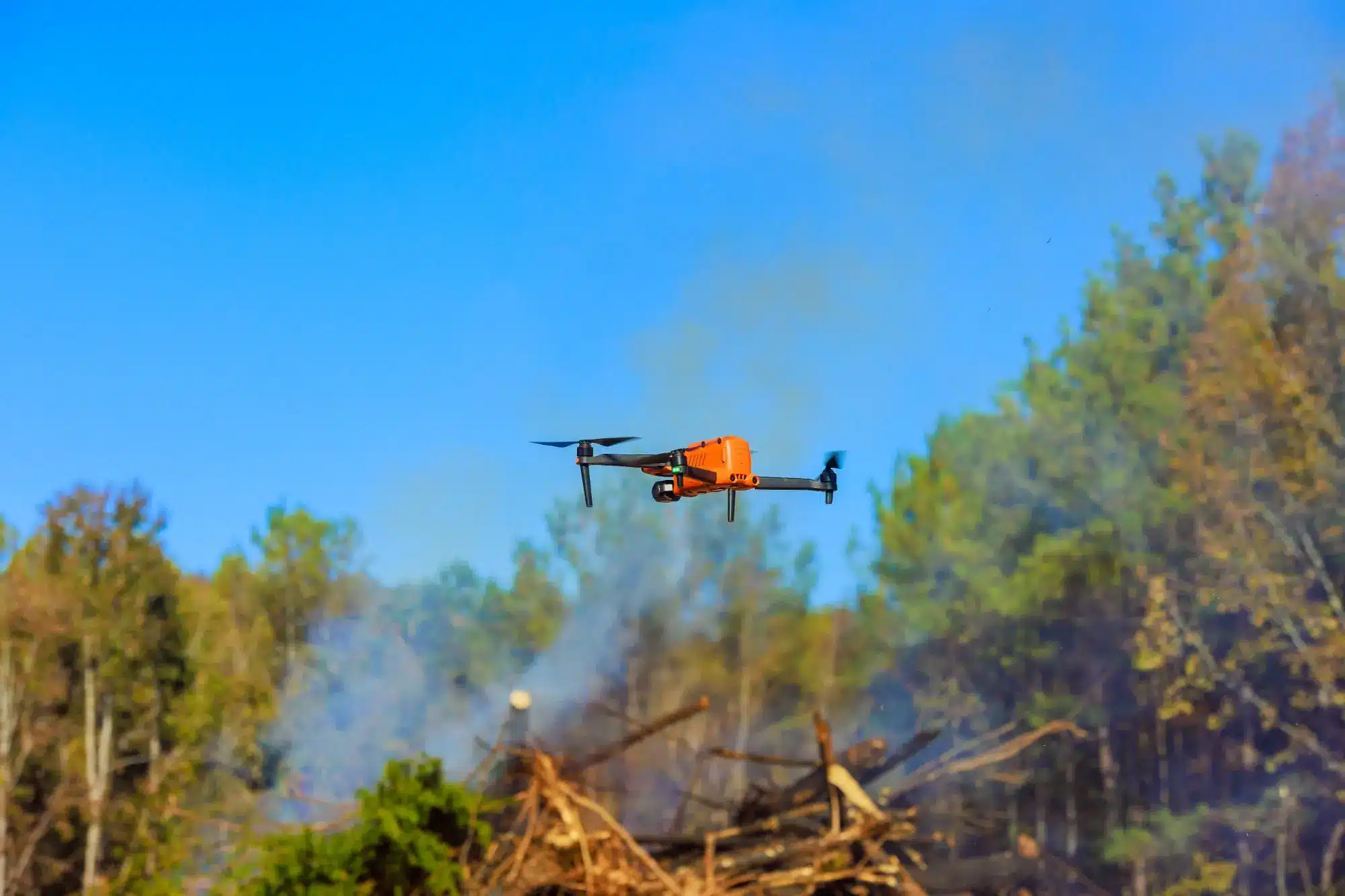
How quickly can drone services deploy for wildfire damage assessment?
Professional drone services for wildfire damage assessment typically deploy within 24-48 hours of access clearance, representing a critical advantage over traditional ground-based inspection methods that can take 3-5 days to mobilize. Struction Solutions maintains a catastrophe response protocol that pre-positions drone pilots and certified inspectors based on wildfire tracking data, enabling immediate deployment once safety perimeters are established.
This rapid response capability is supported by a network of 1,000+ certified professionals strategically located across wildfire-prone regions. The company’s multi-state licensing and Blue UAS/NDAA-compliant drone fleet eliminate regulatory delays when operating in federal disaster zones. During active wildfire seasons, teams are pre-staged with dedicated equipment including thermal imaging cameras and backup drone systems, ensuring 24/7/365 operational readiness.
The systematic approach has enabled consistent 24-48 hour response times across every major U.S. disaster since the early 2000s, including large-scale wildfire events in California, Oregon, and Colorado. The VCA Software platform integration provides automated workflow management and real-time data transparency that maintains processing speed regardless of event scale or complexity.
What advantages do tethered drones provide for extended wildfire monitoring operations?
Tethered drones offer significant operational advantages for extended wildfire monitoring by providing continuous aerial surveillance without battery limitations that restrict conventional drone flight times to 20-30 minutes. Struction Solutions partners with Hoverfly Technologies to deploy tethered drone systems capable of maintaining 24/7 aerial observation positions over active fire perimeters, incident command posts, and evacuation zones.
The continuous power supply through the tether cable enables unlimited flight duration for persistent monitoring of fire behavior, spot fire detection, and real-time situational awareness for incident commanders. Tethered systems maintain stable hover positions even in high-wind conditions common near active fire fronts, providing consistent data streams for thermal imaging analysis and smoke pattern tracking.
For public safety departments managing wildfire response, tethered drones eliminate the logistical burden of battery swapping rotations and pilot shift changes required by conventional drone operations. The systems can be rapidly deployed from mobile command vehicles, providing immediate aerial intelligence within minutes of arrival at incident scenes. This technology proves particularly valuable during overnight monitoring operations when visual observation is limited and thermal imaging becomes critical for detecting hidden hot spots and flare-ups that could threaten containment lines.
How does thermal imaging technology detect wildfire damage that visual inspections miss?
Thermal imaging technology detects critical wildfire damage indicators invisible to visual inspection by identifying heat signatures, moisture intrusion, and structural compromise hidden beneath surface materials. Struction Solutions’ thermal imaging drones can detect smoldering embers within wall cavities, attic spaces, and beneath roofing materials up to 48 hours after apparent fire suppression, preventing re-ignition events that threaten structures during demobilization phases.
The technology identifies compromised building envelope integrity caused by radiant heat exposure, revealing thermal bridging patterns that indicate damaged insulation, melted vapor barriers, and fire-weakened structural members. For insurance claims processing, thermal imaging provides documented evidence of heat damage to HVAC systems, electrical components, and plumbing that may not show visible fire damage but requires replacement due to material degradation.
The cameras detect moisture intrusion from firefighting operations that can lead to mold growth and structural deterioration if not properly documented and remediated. During post-wildfire safety assessments, thermal imaging identifies areas of potential structural instability by revealing temperature differentials that indicate load-bearing member damage. Struction Solutions integrates thermal imaging data directly into carrier systems through VCA Software platform, enabling adjusters to prioritize properties requiring immediate attention versus those suitable for standard processing protocols.
What role do Blue UAS compliant drones play in government wildfire response contracts?
Blue UAS compliant drones are mandatory for federal wildfire response contracts due to National Defense Authorization Act (NDAA) requirements that prohibit Chinese-manufactured drone technology in government operations. Struction Solutions’ partnership with Skydio provides access to domestically-approved drone platforms that meet stringent cybersecurity standards required for sensitive government disaster response missions.
The Blue UAS certification ensures data captured during federal wildfire assessments remains secure within approved data transmission protocols, addressing national security concerns regarding foreign access to critical infrastructure mapping and damage assessment information. For government agencies managing FEMA Public Assistance and Individual Assistance programs following wildfire disasters, Blue UAS compliance is non-negotiable for contractor eligibility.
The 2024 FAA Reauthorization Act strengthened these requirements, making Blue UAS certification a competitive differentiator for disaster response contractors serving federal clients. Struction Solutions’ Blue UAS-compliant fleet enables the company to operate across federal lands, military installations, and government-funded recovery projects without security clearance delays or equipment substitution requirements. This compliance extends to Community Development Block Grant Disaster Recovery (CDBG-DR) programs where federal funding triggers NDAA compliance obligations for all contracted service providers.
How do drone-based damage assessments reduce wildfire insurance claim processing time?
Drone-based damage assessments reduce wildfire insurance claim processing time by 60% through comprehensive aerial documentation that eliminates multiple site visits and accelerates adjuster decision-making. Struction Solutions’ wildfire assessment protocol captures high-resolution imagery, thermal scans, and structural measurements in a single deployment, providing adjusters with complete damage documentation within 24-48 hours of property access.
The AI-powered analysis systems automatically identify fire damage patterns, calculate roof measurements, detect structural compromise, and generate preliminary damage estimates within minutes of data collection, reducing manual review time by 70%. This rapid processing enables insurance carriers to issue advance payments and mobilize mitigation contractors while traditional manual inspection methods are still scheduling initial site visits.
For catastrophic wildfire events affecting hundreds or thousands of structures, drone assessments enable parallel processing of multiple claims simultaneously through a network of 1,000+ certified professionals, preventing the adjuster bottlenecks that plague major disaster response. The VCA Software platform integration provides automated workflow management, digital claims payments, and real-time data transparency that reduces settlement timelines from weeks to days.
Struction Solutions’ multi-certified adjusters maintain Xactimate levels 2 and 3, NFIP certification, and HAAG certification for fire damage identification, ensuring drone-captured data translates directly into accurate claim estimates without requiring specialist consultations that delay processing.
What safety advantages do drones provide during post-wildfire structural assessments?
Drones eliminate critical safety risks during post-wildfire structural assessments by enabling comprehensive damage documentation without requiring personnel to enter potentially compromised buildings or climb fire-weakened roofs. Wildfire-damaged structures often contain hidden hazards including compromised roof trusses, weakened floor joists, damaged electrical systems, and unstable chimneys that pose severe injury risks to traditional inspection teams.
Struction Solutions’ drone inspection protocol captures detailed high-resolution imagery and thermal scans safely from ground level, providing structural engineers and adjusters with the visual data needed for preliminary safety assessments before authorizing personnel entry. This approach eliminates workers compensation exposure for insurance carriers while actually improving documentation quality through ultra-high-resolution aerial photography that reveals damage patterns impossible to observe from ground level.
The elimination of ladder assist requirements and roof access delays accelerates the inspection timeline by 2-3 days per property during large-scale wildfire events. For structures with active hot spots or smoldering materials, drone-mounted thermal imaging provides critical safety intelligence without exposing inspection personnel to toxic smoke inhalation, heat stress, or structural collapse risks. The technology proves particularly valuable in wildland-urban interface zones where multiple structures require rapid triage assessment to prioritize emergency stabilization and public safety interventions.
How do AI-powered systems improve accuracy in wildfire damage claim estimates?
AI-powered damage analysis systems improve wildfire claim estimate accuracy by automatically detecting fire damage patterns, calculating replacement costs, and identifying hidden damage that human adjusters might overlook during visual inspections. Struction Solutions’ AI algorithms analyze high-resolution drone imagery to distinguish between direct fire damage, radiant heat damage, smoke damage, and water damage from firefighting operations, ensuring appropriate repair protocols and cost allocations for each damage category.
The machine learning system has been trained on thousands of wildfire claim outcomes, enabling it to recognize damage patterns specific to structure fires, wildland fires, and radiant heat exposure scenarios. This specialized pattern recognition reduces estimation errors that lead to costly supplements and reinspections, cutting reinspection costs by 50% according to company performance metrics.
The AI system flags inconsistencies between visible damage and thermal imaging data, alerting adjusters to potential hidden damage requiring further investigation before finalizing estimates. For total loss determinations, the technology provides objective damage quantification that supports faster claim resolution and reduced dispute rates. The integration with VCA Software platform enables continuous learning from adjuster feedback and claim outcomes, progressively improving accuracy across the company’s entire wildfire assessment portfolio.
For more information about implementing comprehensive drone inspection solutions that reduce fraud while improving claim processing efficiency, contact our team to understand how rapid response protocols enhance both fraud detection capabilities and legitimate claim processing speeds.


 Struction Solutions’ Vice President of Field Operations, Tina Rodriguez, oversees and maintains claim life-cycle metrics in XactAnalysis and claim handling and estimating best practices in Xactimate for Struction Solutions.
  Struction Solutions’ Chief Operating Officer, Wayne Guillot, is a results-driven and customer-focused operations manager with over 20 years of experience in the insurance industry.
  Brady Dugan is a dynamic and visionary adjuster with over 23 years of progressive leadership in the construction and insurance industries.